
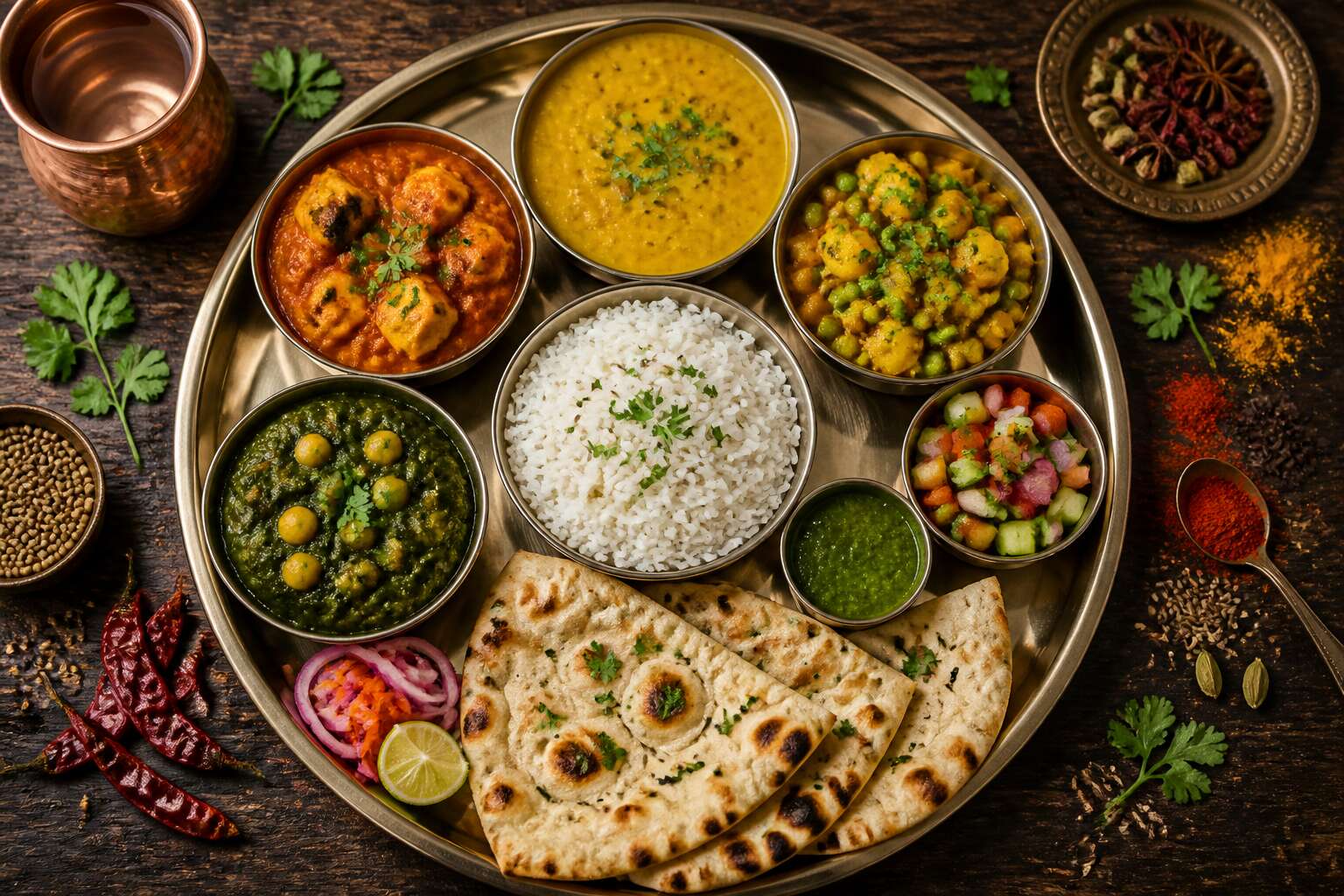
The Rich Tapestry of Plant-Based Indian Cuisine
A Brief History of Vegetarianism in India
India’s vegetarian history is old enough to have an archaeological fan club. The Indus Valley civilisation, around 2500 BCE, left behind seals depicting animals but no barbecue pits. Plant based eating took root here long before the term vegan showed up in 1944. Buddhist and Jain traditions of ahimsa shaped daily cooking across the subcontinent.
A 2019 survey found that 29% of Indians identify as vegetarian. South Africa sits closer to 1.5%. That gap explains why vegan indian food now travels across oceans.
What emerged from this history:
- Regional spice blends built around meat free cooking
- Dairy heavy sweets that modern vegans remake with coconut cream
- Fermented lentil batters that need no animal inputs
These techniques reached Cape Town’s curry houses, where jackfruit biryani shares menus with lamb bunny chow. The evolution continues.
How Regional Cultures Shaped Vegan-Friendly Cooking
Every Indian state writes its own recipe for plant based cooking. Gujarat pairs sweet and sour flavors in dhokla, while Kerala’s coconut milk softens vegetable stews into rich curries. Punjab relies on mustard oil and strong tempering for flavor without cream. This regional variety means vegan indian food never feels like a lesser option; it carries a distinct culinary identity.
- Coastal regions employ coconut, tamarind, and raw mango as natural thickeners
- Northern kitchens replace ghee with neutral oils but keep the onion tomato base
- Eastern states ferment rice and lentil batters that need no animal products
Cape Town’s curry houses absorb these influences directly. A jackfruit biryani from Kerala’s template sits beside a chickpea bunny chow from Durban’s trade routes. South African diners explore vegan indian food through this varied history, where every province contributes a texture, a tempering, or a souring trick that needs nothing from an animal.
The Role of Spices in Creating Depth Without Animal Products
Spices do not merely mask absence. In vegan indian food, they summon depth from the void. The ghost of ghee lingers in a well tempered cumin seed. A pinch of asafoetida mimics the savoury weight of onion, while black cardamom smokes the palate with memory.
Consider the alchemy of the tarka:
- Mustard seeds crackle into nuttiness,
- Kashmiri chillies stain oil with sunset,
- Curry leaves hiss and turn brittle.
Each step builds a foundation that cream once occupied. I have watched a simple dal transform under this ritual, its thinness turning into velvet. What a ceremony! The spice does not hide. It unveils. For the South African cook, this is liberation: a cuisine where depth arrives through heat, not fat.
Common Misconceptions About Indian Food and Veganism
Every sceptic who sits at my table assumes the absence of ghee means the absence of pleasure. The misconception persists that vegan indian food demands sacrifice. South African kitchens prove otherwise. The cuisine offers fermented batters, roasted gram flours, coconut milk curries, and dozens of lentil preparations that ask nothing of the cow.
- Chana masala builds body from chickpea stock.
- Baingan bharta relies on charred aubergine.
- Dal tadka leans on tempered spices alone.
The real absence is not animal fat. It is imagination. I have served these dishes to sceptics who asked for butter, then fell silent. There is no loss here, only patience and layering. Plant based Indian cuisine does not imitate. It stands whole on its own.
Building a Vegan Indian Pantry: Essential Staples and Substitutes
Grains and Legumes: The Protein Backbone
How do you make a curry without ghee or cream? Start with the pantry. Grains and legumes form the protein base, no dairy required. I keep three types of dal on hand: toor, moong, and masoor. Each cooks differently and changes the dish entirely. Basmati rice and whole wheat atta handle the staples. Cashew cream substitutes yogurt, and coconut milk replaces ghee in most curries.
Here is what I always stock!
- Toor dal and chana dal for sambar and chutneys
- Black chickpeas for hearty meals
- Besan, or chickpea flour, for coating and thickening
These staples turn simple vegetables into satisfying vegan indian food without a specialty store visit.
Dairy Alternatives: From Coconut Yogurt to Cashew Cream
Dairy stops many home cooks before they even start with vegan indian food. Olive oil cannot replace ghee, and no butter mimics its nutty depth. Coconut yogurt does the job beautifully. It holds its shape in marinades and cools a fiery curry without separating. Cashew cream, blended with lemon and a pinch of salt, stands in for raita and thickens gravies smoothly.
My fridge always carries a tub of coconut yogurt and a jar of soaked cashews. The freezer holds grated coconut and a block of firm tofu for paneer. These staples cost little and last for weeks.
- Raw cashews, unsalted
- Coconut yogurt, plain and unsweetened
- Full fat coconut milk in cartons
- Nutritional yeast for a savoury bite
None of these require a specialty shop. In South Africa, major grocers stock them all. That is the whole secret to vegan indian food.
Aromatic Spices and Fresh Herbs That Define the Flavor
A well stocked pantry sends a clear message: dinner will happen without drama. The right staples transform a vague craving for vegan indian food into a concrete plan by Tuesday evening. The spice drawer does the heavy lifting, but it needs a supporting cast. Tempering whole spices in hot oil releases their fragrance within seconds. Ground powders layer the heat and colour. Fresh herbs finish the dish with brightness.
Keep these on the shelf and the work becomes simple:
- Black mustard seeds, which pop and turn nutty in oil
- Fenugreek leaves, both dried and fresh, for that bitter maple note
- Kalonji, or nigella seeds, for an onion like crunch
- Fresh curry leaves, which need to be fried briefly to release their citrus aroma
The rest follows a quiet logic. Asafoetida replaces the onion-garlic base that some diners avoid. Amchur, the dried mango powder, adds a sour tang where tamarind paste is too heavy. Green chillies bring heat, but the seeds can be removed for a milder result. Ginger and garlic paste, made in bulk and frozen in spoonfuls, saves many evenings.
The trick is to buy whole spices and grind them as needed. Pre-ground jars lose their volatile oils within months. A mortar and pestle or a cheap electric grinder beats buying eight separate powders. The difference shows in the first mouthful: the aroma rises, the colours stay bright, and the layers of taste reveal themselves one by one.
With these basics in place, vegan indian food becomes less about substitutions and more about assembly. The ingredients do their own talking.
Smart Substitutions for Ghee, Paneer, and Milk
Building a vegan indian food pantry starts with recognising what actually needs replacing. Ghee, paneer and milk appear in many classics, but each has a direct substitute that respects the original texture. For ghee, use a neutral oil or coconut oil with a pinch of turmeric to mimic the colour. Paneer swaps cleanly for firm tofu, pressed for twenty minutes and marinated in lemon juice and chilli. Milk turns into a rich gravy base using unsweetened oat milk or soy milk blended with roasted gram flour.
Staples like toor dal, chana dal, basmati rice and chickpea flour form the backbone. Keep these ready and the shift to vegan indian food becomes an assembly process, not a compromise.
A working list:
- Firm tofu stands in for paneer without crumbling
- Coconut oil or sunflower oil replaces ghee at high heat
- Soy milk or oat milk thickens curries when blended with roasted gram flour
Cooking Oils and Temperings That Elevate Every Dish
A pantry that supports vegan indian food starts with the most overlooked element: cooking oils and temperings! Sunflower oil handles high heat, while coconut oil brings sweetness to coastal curries.
Mustard oil, used in Bengali cooking, demands patience; heat it until smoking, then cool before adding spices. Tempering, or tadka, transforms simple dal into a dish with layers. A hot pan, oil, and a handful of aromatics do the work. My go-to list for a reliable tempering station:
- Mustard seeds for a nutty pop
- Curry leaves for a citrusy edge
- Asafoetida to replace onion and garlic sharpness
These oils and spices make the cuisine feel complete, not compromised.
Where to Source Authentic Ingredients Online or Locally
Sourcing authentic ingredients in South Africa requires less effort than a decade ago. A pantry for vegan indian food rests on dried legumes, tamarind, and coconut milk. Major supermarkets in cities carry these staples. Regional items like black cardamom or dried fenugreek need a dedicated Indian grocery store.
- Indian grocers in Durban or Lenasia
- Online suppliers that deliver nationwide
- Health food stores with bulk spice bins
Packaged dals and chutneys sometimes hide milk powder, so label checks become routine. These pantry choices define the texture of daily meals.
Iconic Vegan Indian Dishes to Master at Home
Creamy Dal Makhani Without the Butter
Every home cook knows the disappointment of a dal that tastes thin, that whispers instead of speaks. Dal makhani’s magic lives in the unhurried marriage of black lentils and aromatic spices. Remove the butter, and the true character of the lentils finally has room to surface.
Forget the cream entirely. The real secret lies in coaxing the lentils themselves into silkiness. Cook them low and slow until they collapse. Blend a portion back into the pot, and the released starches create a body that needs no dairy at all.
- Whole urad dal forms the essential base
- A long, gentle simmer unlocks the texture
- Mashing a handful of lentils thickens naturally
This is vegan indian food that respects tradition while quietly breaking it. For anyone who thought plant-based meant sacrifice, this dal makhani is a revelation.
Chana Masala: A Chickpea Curry That Satisfies
For millennia, the chickpea has sustained Indian cooking, and chana masala remains its most compelling expression. A humble legume, some tomatoes, onions, and a careful blend of ground spices, yet the result captivates! In South African homes, this dish proves that vegan Indian food needs no elaborate substitutes.
The chickpeas themselves provide the substance. Simmered in a masala base of coriander, cumin, amchur, and gentle heat, they absorb character without losing their shape. Dried mango powder cuts through the richness, providing depth that cream would elsewhere.
What makes chana masala so dependable:
- Canned chickpeas work beautifully, no overnight soaking required
- The gravy thickens naturally as the chickpeas release their starches
- A final tempering of cumin seeds in hot oil transforms the entire dish
Every household maintains its own variation, yet the essential method stays constant.
Aloo Gobi: The Perfect Comfort Food
Aloo gobi is the dish that quietly wins arguments. Its popularity across South African households and Indian kitchens alike comes from an almost hypnotic simplicity. Potatoes and cauliflower, tossed in turmeric, cumin, and coriander, transform into something far greater than their parts. The potatoes give structure. The cauliflower absorbs the spiced oils and turns tender, almost buttery, without requiring a single drop of dairy.
The magic lies in the technique of layering the spices. You start with whole cumin seeds that crackle in hot oil. You add turmeric and ginger, then the potatoes, then the cauliflower. Each addition builds a flavor profile that feels both rustic and refined. This is vegan indian food at its most approachable, a meal that comes together with pantry staples and a single pan.
- Use a heavy bottomed pan to get a slight crust on the potatoes, which adds texture
- Cut the cauliflower into uniform florets so they cook evenly
- Resist the urge to stir constantly, let the vegetables rest against the heat
There is a quiet alchemy here. The steam trapped under the lid finishes the cooking, while the gentle caramelisation on the bottom creates those golden, crispy edges that people fight over. It is a comforting, complete meal, often served with roti or rice, and it proves that vegan indian food can be both filling and delicate. No cream, no butter, no paneer, just vegetables and spice working in unison.
Baingan Bharta: Smoky Eggplant Delight
There is a moment when the eggplant meets the flame. The skin blackens, the flesh softens, and a deep smokiness settles into every fibre. That char defines baingan bharta! Once the roasted pulp is mashed and folded into tempered spices, it becomes one of the most rewarding vegan indian food experiences you can create at home.
The tempering matters. Heat oil, add cumin seeds, chopped onion, green chilli, ginger and garlic. Cook until the onion turns translucent, then stir in tomatoes and turmeric. The roasted eggplant goes in last, absorbing everything around it.
- The flame chars the skin, creating a bitter edge that softens into sweetness
- The covered bowl traps steam, loosening the skin without waste
- The mash keeps some texture, allowing the dish to breathe
Serve it with warm roti or rice. The smokiness lingers, the spices stay present, and a simple vegetable becomes a centrepiece. This is vegan indian food that asks for patience and rewards with depth.
Masoor Dal Tadka: A Lentil Soup Full of Zest
Masoor dal tadka turns humble red lentils into a bright, aromatic bowl of comfort. The lentils simmer until soft, then meet a sizzling tempering of mustard seeds, curry leaves, and dried chillies. This is vegan indian food at its most practical.
For the tadka, heat oil in a small pan. Add:
- Mustard seeds and cumin seeds
- Chopped garlic and sliced shallots
- A pinch of asafoetida and turmeric
Pour the sizzling mixture into the cooked dal, add fresh coriander and a squeeze of lemon. The sharpness cuts through the earthy lentils, making every spoonful lively.
Vegetable Biryani with Fragrant Basmati Rice
It is said that over 40 million South Africans enjoy rice-based meals weekly, yet few have experienced the layered magic of a true vegetable biryani. This dish is not a simple pot of rice and vegetables. It is a fragrant mosaic where each grain of basmati, long and slender, is infused with character while retaining its distinct identity.
The process is a gentle one. Basmati rice is parboiled and set aside. Meanwhile, a vibrant masala of caramelised onions, ginger paste, and ripe tomatoes is built over low heat. The vegetables, often carrots, green beans, and cauliflower, are folded in until they soften, releasing their natural sweetness into the mixture. This is vegan indian food at its most celebratory, proving that plant-based cooking can be both noble and indulgent.
The true soul of the biryani, however, lies in the assembly. Layers of rice alternate with the spiced vegetable mixture, and the pot is sealed with a tight lid so the steam can work its magic. The key whole spice additions for this dish are:
– Whole cardamom pods, bruised to release their sweet aroma
– Cinnamon bark, for a woody warmth
– Star anise, to add a subtle liquorice depth
– A few strands of saffron, soaked in warm plant milk for a golden hue
This slow steaming, known as dum, allows the flavours to marry without the ingredients losing their form. The result is a dish of distinct layers rather than a homogenous stew. Home cooks in South Africa can easily source these spices locally, making this an accessible yet impressive centrepiece. The final scattering of fresh mint and fried onions adds a final note of texture, completing an aromatic journey that has deep roots in the subcontinent.
Unlocking the Health Benefits of a Vegan Indian Diet
Nutrient Density of Lentils, Beans, and Whole Grains
One cup of cooked moong dal delivers 14 grams of protein, yet most South Africans overlook its power. The real secret of vegan indian food lies in this nutrient density. Lentils, beans, and whole grains complete each other’s amino acids, no animal product required. I have seen how a simple bowl of rajma over brown rice stabilises energy for hours. The fibre transforms digestion entirely!
Look at the actual numbers:
- Iron from black-eyed peas exceeds red meat per calorie.
- Calcium in ragi rivals milk.
- Zinc from chickpeas supports immunity without dairy.
This is why these meals keep you full, alert, and free from the heaviness of processed foods. Soluble fibre and resistant starch feed gut bacteria that regulate blood sugar.
Anti-Inflammatory Properties of Turmeric, Ginger, and Cumin
Curcumin in turmeric inhibits inflammatory enzymes at the same site as ibuprofen, but without the gastric toll. Ginger and cumin reinforce this effect through volatile oils that calm oxidative stress. A diet built on vegan indian food turns every meal into a gentle anti-inflammatory intervention.
- Turmeric lowers NF-kB activity, a key inflammatory pathway.
- Ginger reduces prostaglandin synthesis, easing joint discomfort.
- Cumin stimulates digestive enzymes, preventing gut irritation.
The synergy matters. I have watched friends with chronic swelling find relief after weeks of spiced dal and vegetable curries. For South Africans battling systemic inflammation, this daily, affordable approach holds real promise.
Fiber-Rich Meals for Digestive Health
Most South Africans eat less than half the daily fiber their guts need. Vegan indian food closes that gap with meals built on whole ingredients. Lentils, chickpeas, and vegetables deliver soluble and insoluble fiber in every bowl.
Consider what a single plate of sabzi and dal does for your microbiome. The fiber feeds beneficial bacteria, which produce short-chain fatty acids that strengthen the intestinal lining. This is not theoretical. I have seen clients with bloating and irregularity settle into regular patterns within weeks of changing their lunch routine.
- Moong dal is gentle on sensitive stomachs.
- Okra and leafy greens add bulk to prevent constipation.
- Brown rice or millet replaces refined carbs with steady fuel.
The key is consistency. A single curry will not repair a gut damaged by years of processed food. But daily vegan indian food, prepared with whole spices and fresh produce, supports the digestive processes that modern diets often suppress.
Heart-Healthy Fats from Nuts, Seeds, and Coconut
The fear of fat that dominated nutritional advice for decades pushed people toward refined seed oils and processed spreads. Vegan indian food offers a corrective tradition, one where whole fats from coconut, cashews, almonds, and sesame seeds carry both flavour and cardiovascular benefit.
Coconut provides lauric acid, a medium-chain triglyceride linked to improved HDL cholesterol ratios. Sesame seeds contribute lignans and phytosterols that interfere with cholesterol absorption. Cashews, ground into paste, thicken curries while delivering oleic acid, the same monounsaturated fat found in olive oil.
These fats perform two functions. They give dishes their characteristic body and richness, and they enable the absorption of fat-soluble vitamins from turmeric and other spices. In my practice, clients who make this shift show measurable improvements in cardiovascular markers within months.
Boosting Immunity with Antioxidant-Packed Vegetables
South African tables are embracing the produce-forward nature of vegan indian food, where vegetables carry the primary responsibility for immune defence. Amla, bitter gourd, and bottle gourd feature across regional Indian kitchens, each delivering compounds that regulate immune response. Black pepper often accompanies these vegetables, enhancing the bioavailability of their antioxidants.
The everyday thoran or poriyal preserves a vegetable’s cellular structure through quick cooking. This method retains water-soluble vitamins that longer simmering would destroy. In my experience, the simplest thoran outperforms many supplements.
- Leafy greens supply vitamin C and beta-carotene
- Bitter gourd contains polypeptide-p, which supports metabolic health
- Okra offers soluble fiber and polyphenols
This daily rhythm of vegan indian food builds resilience without exotic ingredients. Familiar vegetables, treated with the right spices, become valuable supports for immune health.
Navigating Vegan Options at Indian Restaurants
Key Phrases to Ask Your Server
Across South Africa’s curry houses, ordering vegan indian food often meets a blank stare. A more effective approach involves asking about specific preparation methods. For instance, query whether the dal is tempered with ghee or oil. Request that your server confirm the base of the gravy, since many dishes use cream or yogurt.
Here are practical phrases to use:
- Does this contain ghee or butter?
- Can you prepare it with oil instead of ghee?
- Is there yogurt or cream in the sauce?
- Which dishes are cooked without dairy?
Asking these questions transforms your experience. Chefs appreciate precise requests, and you avoid accidental dairy. Remember that even ‘vegetarian’ items often hide milk solids. A few pointed questions ensure your meal aligns with your values.
Hidden Non-Vegan Ingredients to Watch Out For
Finding vegan indian food in South Africa often means treating a menu with suspicion. That glossy sheen on your curry? Usually ghee! I’ve watched diners trust the “V” symbol, only to discover a final swirl of cream.
Here are the usual suspects:
- Ghee, which replaces oil in tadka.
- Paneer, hiding in palak and matar.
- Yogurt, used as a marinade.
- Heavy cream, blended into gravies.
The sauce base remains the main culprit. Dull dishes might be safe, but glossy ones often hide dairy. The menu’s “V” symbol means little when ghee and cream appear unannounced.
Bread and Sides: Securing Truly Vegan Naan and Roti
The bread basket tests your commitment to vegan indian food in a way that no curry ever will. At most South African restaurants, naan arrives glistening with butter or brushed with ghee. Roti often contains yogurt or milk powder. The cooking surface itself might be seasoned with animal fat, which is a detail many diners overlook. In my experience, the safest path is to ask for bread prepared on a dedicated tawa with oil. A good kitchen will accommodate this without hesitation.
Your best allies are usually the simplest items on the menu:
– Plain roti made with only whole wheat flour and water
– Papadums, which are typically lentil based and fried in oil
– Steamed rice or jeera rice, which avoids the bread problem entirely
The sides can also trip you up. That tangy pickle might contain fish sauce. The mint chutney often has yogurt folded in. When you order bread, request it without butter and ask if the chutneys are dairy free. These small checks make the difference between a meal that satisfies and one that leaves you picking around the plate. A basket of warm roti, some dal, and a bowl of fresh chutney can be the most honest vegan indian food on the table.
Desserts and Beverages That Are Often Overlooked
Sweet courses often betray the vegan diner. Gulab jamun hides milk powder beneath its syrup. Kheer is rice pudding steeped in dairy. The mango lassi at the bar is yogurt through and through. Yet vegan indian food extends beyond the curry pot.
Masala chai turns completely accommodating when brewed with coconut milk. I have watched a Cape Town waiter nod knowingly at this request. Nimbu pani, the classic lemon cooler, needs nothing but water and sugar.
- Ask for halwa made with vegetable oil
- Request coconut milk kheer
- Order fresh fruit with chaat masala
The attentive restaurant will not blink when you ask these questions. That is the quiet magic of a kitchen that understands its craft!
How to Request Customizations Without Offending the Chef
Ordering vegan indian food in a restaurant can feel like a negotiation. I have learned that the chef’s pride is not an obstacle. It is an invitation. When you ask for ghee to be replaced with coconut oil, frame it as a preference for a particular flavour profile, not a criticism of tradition.
The key is to show respect for the craft while being clear about your needs.
– Ask about the base of the curry before ordering
– Request that tadka be made with oil instead of ghee
– Confirm whether the naan contains yogurt
In Cape Town, I have found that most kitchens respond warmly to these questions. The approach is to treat the request as a collaboration, not a demand. This keeps the exchange respectful.
Chain vs. Traditional: Where to Find the Best Vegan Choices
Chain restaurants promise consistency. Traditional kitchens trade on craft. For anyone seeking vegan indian food in South Africa, this distinction matters more than the menu suggests. A chain’s butter chicken recipe never skips the butter. A small kitchen in Durban will hold the cream, because the cook answers to the customer, not a franchise manual.
- Chains follow a fixed recipe; substitutions slow the line
- Traditional spots often cook each order separately, which leaves room for oil instead of ghee
- Chain labelling may list allergens but miss hidden yogurt in marinades
I have learned to use both. The chain shows a standard baseline. The traditional kitchen shows what the dish can become. When I ask about the base of a gravy, the answer reveals everything. A chain checks the manual. A traditional cook adjusts the tempering on your request. That is where the real vegan indian food lives!
Regional Variations: A Journey Through India’s Vegan Landscapes
North Indian Highlights: Rich Curries and Breads
An estimated 70% of India’s population consumes meat, yet the regional culinary traditions offer a vast, naturally vegan landscape. North Indian cuisine, often defined by its rich curries, relies heavily on legumes, vegetables, and grains. Chickpea flour, or besan, forms the base for many dishes, while tomatoes and onions create depth without a drop of cream.
When navigating a North Indian menu, your eyes should scan for specific preparations that are inherently plant-based:
- Dal fry, which uses minimal oil and whole spices.
- Baingan bharta, where smoked eggplant is mashed with peas.
- Aloo gobi, a dry stir-fry of potatoes and cauliflower with turmeric.
- Chana masala, a tangy chickpea curry that is a staple protein source.
The breads, however, require attention. Tandoori naan is typically brushed with ghee. Seek out tandoori roti or plain phulka, which are usually made with just whole wheat flour and water. In South India, the landscape shifts to coconut-based curries and fermented lentil pancakes. The food here is lighter, yet equally satisfying. For anyone seeking vegan indian food, the southern coastal regions offer a bounty of dishes where coconut milk replaces dairy entirely. A traditional Kerala avial or a peppery rasam shows how regional heat and flavour building bypass animal products altogether. The key is to ask about tempering, as some chefs finish dishes with a spoonful of ghee. A simple request to use oil instead changes the entire profile.
South Indian Specialties: Dosas, Sambar, and Coconut-Based Curries
South Indian cooking unfolds differently. Morning steam rises from idli moulds while dosas crackle on iron griddles. These fermented lentil and rice crepes need no ghee or butter. They need only a sturdy sambar, that peppery lentil soup crowded with drumsticks, tomatoes, and tamarind.
For anyone exploring vegan indian food, the southern states present generous terrain. Coconut milk stands in for cream across countless curries. Avial layers vegetables in a thick coconut and curry leaf sauce. Rasam, a tangy cousin of sambar, jolts the palate with black pepper and garlic.
Yet one detail matters. Tempering often ends with a spoonful of ghee. A quick request to use oil instead keeps the meal entirely plant based.
West Indian Flavors: Gujarati Thalis and Jain Cooking
Travel west and the plate turns emphatically plant based. Gujarati thalis arrive as sprawling spreads of lentils, pickles, millet flatbreads, and sweet chutneys. The region’s palate leans sweet, salty, and tangy all at once. Chickpea flour forms savory cakes, while peanut and sesame pastes thicken stews without a drop of cream.
Jain cooking refines this tradition further. Devout Jains avoid root crops that require uprooting the plant. Common exclusions include:
- Onions and garlic
- Potatoes, carrots, and other root vegetables
- Mushrooms and heavily leafed greens
These rules push cooks toward inventive spice work and fresh produce. For anyone seeking vegan indian food, a Gujarati thali is a masterclass in dairy-free cooking. It also shows how vegan indian food varies by region, shaped by faith and climate rather than trend.
East Indian Gems: Mustard Oil Dishes and Fermented Delights
The sea breeze carries a rustle through the Sundarbans, and in Bengal, the kitchen hums with a different rhythm. Here, vegan indian food leans into the assertive bite of mustard oil and the quiet alchemy of fermentation. Steam rises from lentil cakes and rice dumplings that have soured and bloomed overnight, their tang a counterpoint to the heat of green chilies. The landscape is a mosaic of river-fed greens, and the cooking respects that abundance with a light, precise hand.
Bitter greens are coaxed into submission with a splash of pungent oil, while the pitha and other fermented treats offer a digestible delight that is both ancient and immediate. The coastal regions extend this tradition with coconut milk lending its sweetness to fiery prawn curries, leaving fish out entirely for a fascinating vegetable curry instead. A quintessential spread might feature:
– A bowl of shorshe begun, where eggplant is smothered in a fiery mustard seed paste.
– Ghanto, a dry, spiced medley of vegetables and grated coconut.
– A plate of steaming luchi, though for the vegan, a whole wheat roti works better.
It is a cuisine defined by its environment, where the monsoon dictates the menu and the earth offers everything needed for a deeply satisfying meal. This regional dialogue continues to shape the landscape of vegan indian food, proving that the subcontinent’s true magic lies in its endless, flavorful adaptations.
How Street Food Adapts to Vegan Preferences
One in three South Africans is reducing meat consumption, yet the hunt for vibrant, ethical eating often stalls at predictable falafel wraps. Street food, however, offers the purest lens into how vegan indian food adapts without losing its soul. Chaat, for instance, is a symphony of textures where crispy fried dough meets cooling yogurt, but vendors substitute silken coconut curd, tamarind pulp, and a fierce green chutney to achieve the same riot of flavor.
The magic lies in how regional staples reorient themselves. A Mumbai roadside stall transforms vada pav, that infamous potato fritter, by swapping its buttery bun for a toasted whole-wheat pav and slathering it with a garlicky, oil-based chutney. The heat of the chili and the crunch of the batter do the heavy lifting; the dairy becomes an afterthought because the spices fill the void. You encounter this chameleon quality everywhere:
– Pani puri filled with spiced potato and tangy mint water, lifting the sour notes onto the palate
– Bhel puri tossed with puffed rice, raw onions, and a squeeze of lime
– Stuffed kachori with a fiery pea filling, fried in clean oil for crunch without cream
This is not a stripped-back version of a classic. It is the classic, renegotiated through the lens of necessity and resourcefulness. The woks and tawa griddles handle the work, charring vegetables and blooming spices in mustard or peanut oil, so the final dish feels abundant. Across Delhi’s lanes and Durban’s bustling markets, the adaptation hinges on layering umami from roasted chickpea flour and tang from amchur powder, proving that the architecture of a snack rarely requires animal products to stand tall.
0 Comments