
Historical and Cultural Roots of Indian Spices
Ayurvedic Origins of Spice Blending
India’s spice legacy predates written history. The Rigveda, composed around 1500 BCE, references cinnamon and cardamom in ritual offerings. This culinary heritage grew from Ayurveda, where spices served as medicine before they became flavour. The answer to why indian food is so spicy involves balance, not pure heat.
Ayurvedic practitioners developed spice blends like garam masala to balance the three doshas. Each spice has a specific effect on the body. Turmeric reduces inflammation, while cumin aids digestion. These pairings emerged from centuries of observation.
- Black pepper traded along the Malabar Coast as early as 1000 BCE
- The spice trade shaped empires, from Rome to the Dutch East India Company
- Pepper was valued so highly that it served as currency in some regions
So when you ask why indian food is so spicy, the answer involves trade routes, tropical climate, and a medical system that viewed food as preventative care. Spice was never about showiness. It was about preservation and health in a climate where food spoiled quickly.
How Geography and Climate Shape Spice Usage
Hot Climates and the Need for Natural Preservation
India’s tropical heat makes food spoil within hours, a problem that defined daily cooking for centuries. Without refrigeration, households needed methods to keep ingredients safe. Spices provided the answer. Turmeric contains curcumin, which fights bacteria, while capsaicin in chillies deters microbes.
This practical need is a core reason why Indian food is so spicy. Cooks in humid regions discovered that aggressive spicing extended the life of curries and vegetables. I find it striking how directly climate dictated survival strategies in the kitchen.
Common preservation mechanisms included:
- Cinnamon and cloves halted fungal growth
- Mustard seeds released antimicrobial compounds when crushed
- Fenugreek masked the taste of slightly stale grains
Geography shaped an entire culinary logic. The resultant boldness we associate with Indian cuisine once served a direct, protective function against the environment.
Regional Variations: Coastal, Desert, and Mountain Cuisines
Geography writes its own rules for spice. A coastal kitchen in Goa, a desert home in Jodhpur, and a mountain hearth in Ladakh all answer one question: how much heat does survival demand? Coastal cooking uses fresh aromatics, while desert and mountain cuisines push preservation to different ends.
- Coastal: coconut, turmeric and curry leaves fight humidity.
- Desert: dried chilies and amchur mask scarce water.
- Mountain: cloves and asafoetida warm cold valleys.
These variations, I think, explain why indian food is so spicy. Each region adjusted its spice intensity to its environment, so the heat on your plate indicates exactly where it came from.
The Monsoon Season and its Impact on Cooking Methods
Monsoon rains dictate the rhythm of Indian kitchens. When humidity saturates the air, chefs rely on quick frying and oil-based tempering to seal flavours. This method, known as chaunk, blooms whole spices in hot ghee, releasing volatile oils in seconds.
Geography also determines what grows where. The Western Ghats receives over 400 inches of rain, producing peppercorns and cardamom. Dry plateaus host chilies and cumin. Every family adopts storage techniques to survive the wet season: sun-drying, pickling, and fermentation.
- Sun-dried mango powder adds sourness without perishable moisture.
- Fermented rice batters carry probiotic heat that endures humidity.
- Pickled limes hold their pungency through months of downpour.
These climate-driven adaptations answer why indian food is so spicy. The heat is not mere preference; it is a year-round strategy to keep meals safe and vibrant when water itself becomes unpredictable.
The Role of Agriculture and Locally Grown Spices
India’s spice belt tells a story of terroir. In Kerala, black pepper vines climb tall trees in humid shade, producing berries with sharp, resinous heat. Up in the Himalayas, Timur peppers offer a citrusy, numbing kick that you won’t find in commercial red chili. These regional crops directly shape why indian food is so spicy. Local cooks use what thrives nearby, not imported substitutes. Agriculture determines the heat profile.
Consider the following:
– Karnataka’s Byadgi chilies are mild and smoky, used for color.
– Andhra’s Guntur chilies carry intense fire, prized for heat.
– Tamil Nadu’s black peppercorns bring a slow burn, not a blast.
Spice farming is rain-fed and organic by default. When a family harvests their own turmeric, they use it fresh and ground on stone. The result is a cuisine where spice is not an additive; it is the foundation of every meal, rooted in the soil itself.
Health and Medicinal Benefits of Spicy Foods
Cooling the Body: The Thermodynamic Paradox
The thermal signature of a fiery curry seems counterintuitive. Yet the sharp, pricking heat of chillies triggers a physiological response that cools you from within. When capsaicin binds to pain receptors, your body responds by perspiring. That moisture evaporating from your skin draws heat away from the core, creating an evaporative cooling effect. This is precisely why indian food is so spicy, it is a deliberate, edible air conditioner for tropical climates.
Beyond temperature regulation, spicy ingredients carry medicinal weight. Common additions in Indian kitchens perform specific functions:
- Turmeric reduces inflammation
- Cumin aids digestion
- Ginger soothes nausea
The heat itself accelerates metabolism and releases endorphins, which acting as natural painkillers, produce a mild euphoria. In South African summers, this thermodynamic paradox offers relief!
Natural Antimicrobial Properties of Common Spices
Indian cuisine offers more than heat. The spices that define its character deliver measurable health benefits. Capsaicin from chillies stimulates blood flow. Turmeric contains curcumin, a compound studied for its ability to reduce oxidative stress. Ginger and garlic support immune function. Together these ingredients explain why indian food is so spicy for many families: it is both medicine and meal!
Several common spices also possess natural antimicrobial properties. Research shows that cumin and coriander inhibit bacterial growth in cooked dishes. Clove and cinnamon contain eugenol and cinnamaldehyde, compounds that fight pathogens.
- Fenugreek lowers blood sugar
- Cardamom aids respiratory health
- Black pepper increases nutrient absorption
In South Africa, where warm weather encourages foodborne bacteria, these antimicrobial qualities matter. Spices preserve meals and protect eaters, making the heat a practical safeguard as much as a flavour choice.
Boosting Digestion and Metabolism Through Food
Capsaicin, the compound responsible for the bite in chillies, does more than register on the tongue. It nudges the body’s core temperature upward, prompting a measurable rise in metabolic rate for hours after a meal. The body works harder to cool itself, which means more calories burned during digestion!
Beyond the burn, many Indian spices trigger the digestive tract into action. Cumin and fennel stimulate salivary glands and gastric juices, making heavy meals easier to process. Ginger encourages bile production, while black pepper’s piperine assists in nutrient absorption. I find this is part of the reason why indian food is so spicy: the heat actively prepares the body to handle rich, complex dishes.
- Turmeric supports liver function and fat metabolism
- Coriander seeds ease bloating after heavy meals
- Asafoetida, a pinch added to dal, prevents gas
For South African diners, this helps explain why indian food is so spicy: the heat works with the body, not against it. A plate seasoned with bold spices keeps the stomach working efficiently!
Anti-Inflammatory Benefits of Turmeric and Ginger
Turmeric and ginger are not merely there to make your palate question its life choices. They function as a botanical pharmacy hiding in your curry. Curcumin, the active compound in turmeric, is a potent anti-inflammatory agent that researchers have compared favourably to some over-the-counter medications, minus the stomach rebellion. Ginger contains gingerol, a substance that targets the same inflammatory pathways as ibuprofen, though it tastes considerably better on roti.
The medicinal utility is why indian food is so spicy. The heat serves a practical function. Spices deliver measurable physiological effects, not theatrical flavour drama.
– Turmeric’s curcumin reduces joint inflammation and supports cognitive health through improved blood flow
– Ginger’s gingerol eases muscle soreness and menstrual pain, making it a multi-purpose kitchen remedy
– Both spices inhibit the COX-2 enzyme, a primary driver of inflammatory responses in the body
For many South Africans, this medicinal dimension answers why indian food is so spicy: it is a cuisine designed around wellness, not just entertainment. The spice is the medicine, and the medicine happens to taste exceptional.
The Art and Science of Balancing Flavors
The Six Tastes and the Quest for Gastronomic Harmony
In the panoply of global cuisines, Indian cooking treats spice as one element among many. The six tastes, sweet, sour, salty, bitter, pungent, and astringent, form a framework that compels the chef toward equilibrium. Pungency from chilli is tempered by the cool sweetness of coconut or the sour twang of tamarind.
This pursuit of harmony explains why Indian food is so spicy, yet never merely hot. A well-executed curry dazzles the palate with layered sensations rather than assaulting it. Consider the quiet work of ghee, which rounds off sharp edges. I find the humble lentil even more impressive, absorbing excess heat and transforming it.
- Sweetness in raisins or jaggery softens pungency
- Sourness from amchur or kokum brightens heavy dishes
- Bitterness in fenugreek or neem cuts through richness
The result is a cuisine where no single flavour dominates. Every plate becomes a negotiation between the senses and memory.
Layering Flavors: Tempering, Roasting, and Grinding
A single mustard seed crackling in hot oil tells you more about Indian cooking than any recipe. Tempering, or tadka, releases fat soluble compounds that raw spices simply cannot offer. The oil carries those molecules across the entire dish, coating every ingredient in a uniform warmth. This layering is part of why Indian food is so spicy, but the heat is never blunt.
Roasting and grinding add another dimension. Whole spices like coriander and cumin go into a dry pan until their essential oils surface. Then they cool and get ground fresh. The result is a fragrance that powdered supermarket spices can only approximate.
- Whole spices roasted low and slow.
- Ground spice blends added at different stages.
- Fresh herbs stirred in just before serving.
Every stage changes the flavour profile. A curry built this way develops sweetness, bitterness, and pungency in separate waves, not all at once.
Not All Heat is Equal: Comparing Chili and Black Pepper
Two different chemicals create the heat in Indian food. Many people never notice the difference. Capsaicin lingers on the tongue. Piperine arrives sharp and disappears quickly. South African cooks often treat heat as one value. That is a mistake. Indian cooking treats it as a sequence. The care in matching these two molecules explains why indian food is so spicy without being punishing.
- Black peppercorns are crushed and added early to release volatile oils.
- Green chilies enter later for sustained heat.
- Ground pepper is sprinkled at the end for immediate sting.
Each ingredient triggers a distinct reaction. The tongue registers these reactions in order. That sequence creates balance and turns a curry into a precise formula.
The Sensory Experience: Aroma, Texture, and Presentation
The aroma of a hot pan of tadka drifts through the air before the curry reaches the table. That scent primes the tongue and tells the eater what is coming. This is why indian food is so spicy yet never feels careless. The heat is announced, then delivered in stages.
Texture carries the next part of the story. A single bite may combine crispy fried onion, soft potato, and thick gravy. Each texture holds spice differently. Some release heat immediately. Others let it bloom slowly!
Visual presentation completes the experience:
– A gloss of oil on the curry signals slow-cooked spice.
– Fresh green chili rings mark the sharpest heat.
– A swirl of yogurt offers a cooling counter.
These signs prepare the mouth before the first bite. I have come to respect how Indian spice follows this exact order. Every sense carries a piece of the message.
Essential Spices and Their Unique Contributions
The Foundation: Turmeric, Cumin, and Coriander
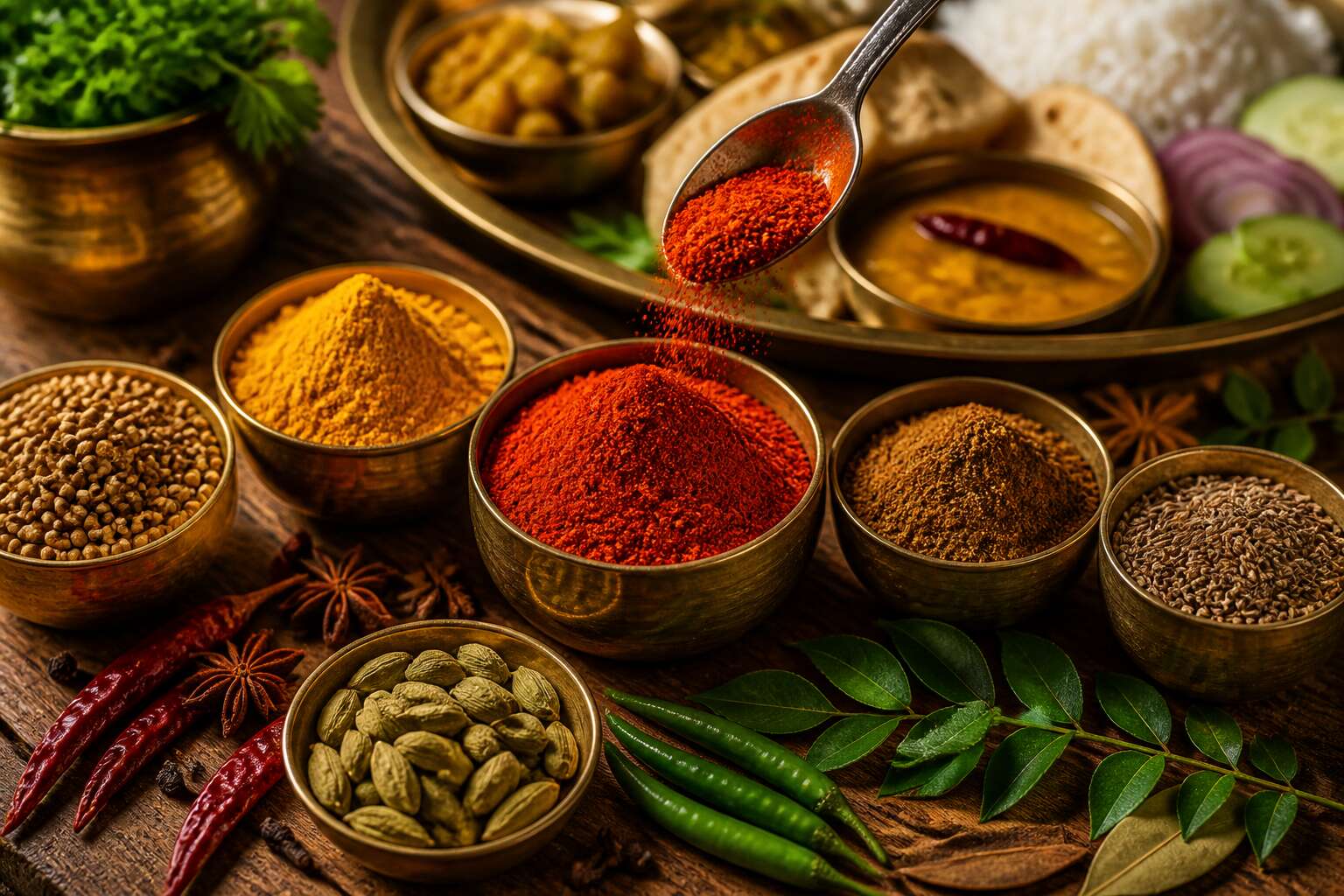
The question of why indian food is so spicy often obscures an underlying truth. The heat is merely a consequence of a foundational trinity: turmeric, cumin, and coriander. Turmeric delivers an earthy bitterness and a deep golden color, its aroma reminiscent of fresh roots. Cumin contributes a nutty, smoky character that gives many gravies their structure. Coriander seeds add a citrusy sweetness, a gentle counterpoint that binds the other two together.
These three spices are not interchangeable; they work in sequence. Tasting them individually reveals their roles. The spiciness we perceive is not the goal. It is the result of this careful layering. Understanding this dynamic is the first step in answering why indian food is so spicy, because the answer lies in balance, not in raw chili heat.
The Flavor Complex: Cardamom, Cinnamon, and Cloves
Cardamom, cinnamon, and cloves form a different layer. These aromatics linger after the meal ends. Cardamom brings a cool, almost eucalyptus-like sharpness that cuts through rich gravies. Cinnamon offers a woody sweetness that suggests warmth without the burn. Cloves carry a numbing intensity that arrives late, then fades.
What fascinates me is how they appear in dishes where you would never expect them. Biryani receives a whole cinnamon stick. Chai gets crushed cardamom pods. Cloves stud the surface of slow cooked kormas.
- Cardamom pods are often bruised, not ground, to release their oils slowly.
- Cinnamon bark is added whole and removed before serving.
- Cloves are used sparingly because three or four can dominate an entire pot.
Each of these spices answers the question of why indian food is so spicy through complexity rather than heat. The sweetness of cinnamon and the sharpness of cardamom trick the palate into perceiving more depth than any single chili could provide.
The Heat Providers: Green Chilies and Black Pepper
Green chilies and black pepper provide the initial heat in Indian cooking. Green chilies deliver a bright, immediate sting that fades quickly. Black pepper works slowly, building a dry, prickly warmth with each bite. Together, they create a tension that explains why indian food is so spicy without relying on a single overpowering flavor.
These two are not interchangeable. Their contributions differ:
- Green chilies offer a raw, herbal sharpness that diminishes when cooked.
- Black pepper brings a fermented sharpness from its long drying process.
Cooks often add chilies early to infuse oil, and pepper late to preserve its volatile oils.
Signature Blends like Garam Masala and Curry Powder
Walk into any Indian kitchen and you will find a tin of garam masala, a blend that varies from family to family. It acts as a blueprint. The name literally means “warm spice mix,” and it often includes black pepper, coriander, and bay leaves. Because each household toasts and grinds its own ratio, the blend becomes a signature.
Curry powder is a Western invention, a colonial shorthand for a dozen flavour profiles. It typically combines turmeric, cumin, and fenugreek. Both blends answer why indian food is so spicy, but differently. Garam masala adds finish, curry powder adds body.
- Garam masala goes on at the end to preserve aroma!
- Curry powder is cooked into the oil early to release depth.
These blends move beyond heat. They focus on balance, and that is the real reason why indian food is so spicy without being punishing.
The Finishing Touch: Fresh Herbs and Dried Spices
Consider the mustard seed! It pops in hot oil, releasing a nutty aroma that defines countless dishes. Along with asafoetida and curry leaves, it forms the backbone of South Indian cooking. These essential spices build a foundation of flavor. This is a primary reason why indian food is so spicy, yet balanced.
Then comes the finishing touch! I find that fresh coriander and mint brighten a finished plate, while dried fenugreek leaves add a subtle sweetness. A final tempering of whole spices in ghee can transform a simple lentil dish. Here is how the finishing layer works:
- Fresh herbs are added just before serving to preserve their volatile oils.
- Dried spices are bloomed in hot oil to release their essential flavors.
This layering of fresh and dried elements creates complexity. That complexity is the true answer to why indian food is so spicy without overwhelming the palate.


0 Comments